
More customers are now using artifical intelligence (AI) to work out what is wrong with their boiler or plumbing before calling an engineer. There’s nothing wrong with that. AI can explain fault codes, suggest possible causes and help homeowners understand their heating system better.
The problem starts when a possible cause becomes a diagnosis.
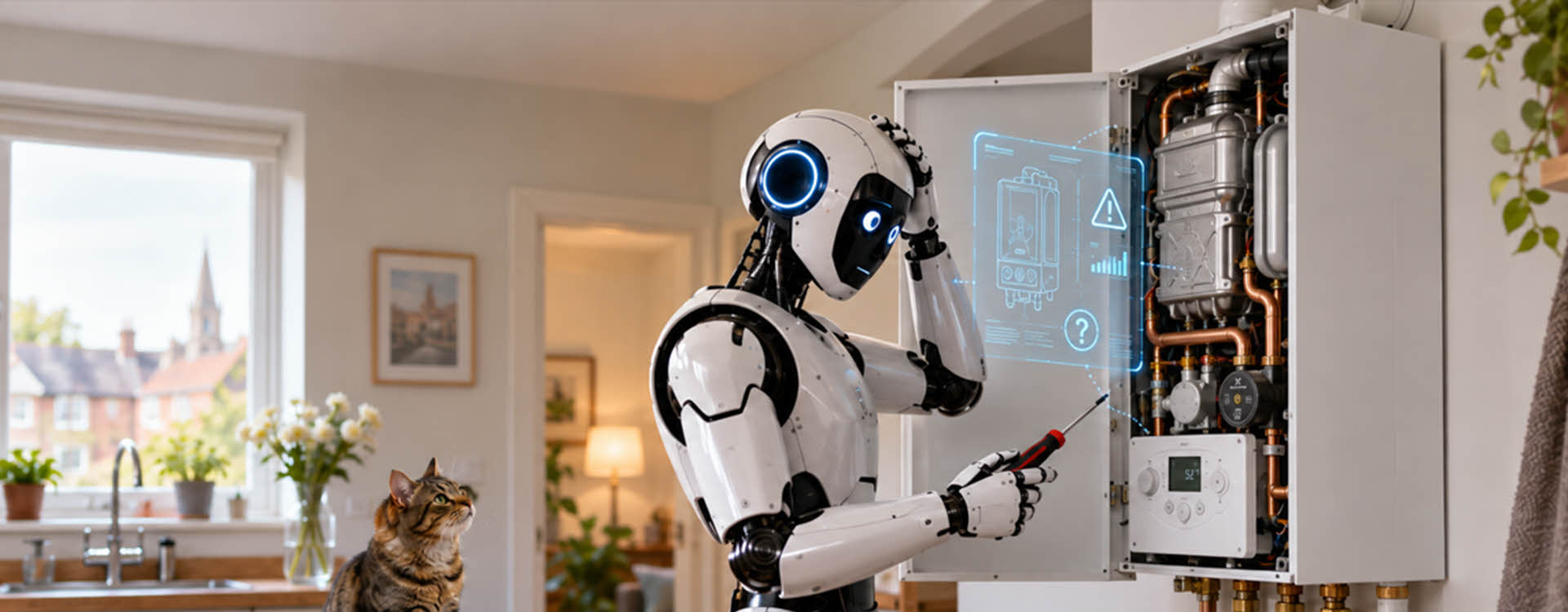
At Celsius Plumbing and Heating, we’re increasingly attending jobs where customers already believe they know which part has failed. From our own recent experience, around 9 out of 10 of these customer-supplied diagnoses have been incorrect.
That can end up costing the customer more, not less.
AI can suggest a boiler fault, but it cannot diagnose it
AI only knows the information you give it. It cannot stand in front of your boiler, hear the exact noise it is making, watch the ignition sequence or see what happens when the fault occurs.
It also cannot physically inspect components, take readings or test how different parts of the boiler and heating system are working together. That is the key difference between information and diagnosis.
AI may give you several sensible possibilities, and some of them may well form part of an engineer’s thinking. But an experienced heating engineer can actually test those possibilities and establish which one is causing the problem. For us, that is still the best starting point for any boiler repair we undertake in Edinburgh.
“AI thinks it is highly likely to be the gas valve”
We recently received an enquiry from an Edinburgh customer with a Glow-worm Flexicom CX30 combi boiler. They were experiencing a 20-30 second delay when turning on the hot water, followed by a loud bang before the boiler fired. They were also seeing an F14 fault code.
After discussing the symptoms with AI, they were given several components to investigate, including the gas valve, PCB and domestic hot water temperature sensor. The customer then told us:
“You are the experts but AI seems to think it is highly likely to be the Gas valve.”
It is a great example of what we are seeing more often. The AI response sounded detailed and technical, but the boiler had not actually been diagnosed.
The technical detail provided by AI can sound more certain than it really is
The AI response even suggested specific tests using a multimeter and pressure gauges. To a homeowner, that level of technical detail can make the answer feel very convincing.
But none of those tests had actually been carried out. AI had not inspected the appliance, checked the gas valve, tested the PCB outputs or taken any measurements from the boiler.
An engineer may decide to investigate some of those same areas, but they may also find something during testing that completely changes the direction of the boiler fault diagnosis.
That ability to react to what is physically happening in front of you is a major part of proper fault finding. A detailed answer can still be wrong if it is based only on symptoms rather than real test results.
Why we won’t automatically replace the part AI suggests
Sometimes customers ask us to attend and simply replace the component AI has suggested. We can carry out requested work where appropriate, but we always make the customer aware of the risk first.
If we replace the requested part and the original fault remains, the charge for that work still stands. We would then need to diagnose the boiler properly and provide a further quotation for the repair that is actually required.
That could mean paying for a part that was not needed, the labour to fit it, further diagnosis and then the correct repair afterwards.
We would much rather diagnose the boiler fault first and give the customer a clearer understanding of what we have found, what needs repaired and what they are being quoted for.
Boiler faults are not always as straightforward as they look
Boilers can produce similar symptoms for very different reasons. A fault code may point an engineer towards a particular area of the appliance, but it does not always mean a specific component needs replacing.
Sometimes a component is reacting to another fault elsewhere in the boiler or heating system. The same applies to problems such as pressure loss, intermittent hot water, unusual noises or poor heating performance.
Good diagnosis means looking at the full picture. That includes the symptoms, test results, condition of the boiler, heating system, previous repairs and what the engineer sees while the fault is happening.
The aim should not be to replace the most obvious part. It should be to understand why the system is not working properly in the first place.
Nearly 20 years of Celsius experience
Celsius Plumbing and Heating has been working in Edinburgh since 2007. During that time, our engineers have attended many thousands of boiler repairs, heating and plumbing faults in homes and businesses.
Across our team, we have plumbers and heating engineers with experience ranging from around 5 years to 60 years in the trade.
That experience matters. An engineer who has dealt with similar faults hundreds of times can often recognise patterns, spot unusual behaviour and know when something does not quite add up.
AI has access to a huge amount of information. What it does not have is decades of physically inspecting boilers, tracing faults and learning from thousands of real repairs.
That hands-on experience still has enormous value.
So in summary, should you use AI for boiler advice?
Yes. AI can be useful for understanding fault codes, learning how your boiler works and helping you prepare questions before an engineer arrives.
Where we would be cautious is using an AI answer to diagnose which part should be replaced.
There is a big difference between asking “What could cause my boiler to lose pressure?” and “Which part do I need to replace?”
The first question helps you understand the possibilities. The second assumes the problem has already been diagnosed.
If you have used AI before calling us, tell the engineer what it suggested. There is nothing wrong with that. We simply recommend allowing the engineer to carry out their own tests before any repair decision is made.
Let a qualified GasSafe engineer diagnose the fault
When our engineer arrives, tell them everything you have noticed. That includes fault codes, noises, pressure changes, previous repairs and when the problem usually occurs.
Once we have investigated the fault, we can explain what we have found, what needs to be repaired and what you are being quoted for.
That gives the customer a much clearer picture before money is spent on parts.
AI is going to become a bigger part of how people research plumbing and heating problems, and used properly it can be genuinely useful. But diagnosing a boiler is not simply about matching symptoms to an answer on a screen.
Sometimes you need to see it. Sometimes you need to test it. And sometimes you need years of experience to know what you are really looking at.
Use AI to ask questions. Use an engineer to find the fault and undertake the repair.
Based in Edinburgh and need your boiler fault diagnosed?
If your boiler is showing a fault code, making unusual noises or simply not working as it should, our heating engineers can help.
We will investigate the problem, explain what we have found and let you know what needs to happen next.
No guessing which component to change. No replacing parts simply because an AI tool suggested them.
Just proper fault finding backed by real-world experience from qualified and GasSafe certified heating engineers.













John Taylor
Categories:
Boilers News Plumbing Hacks